



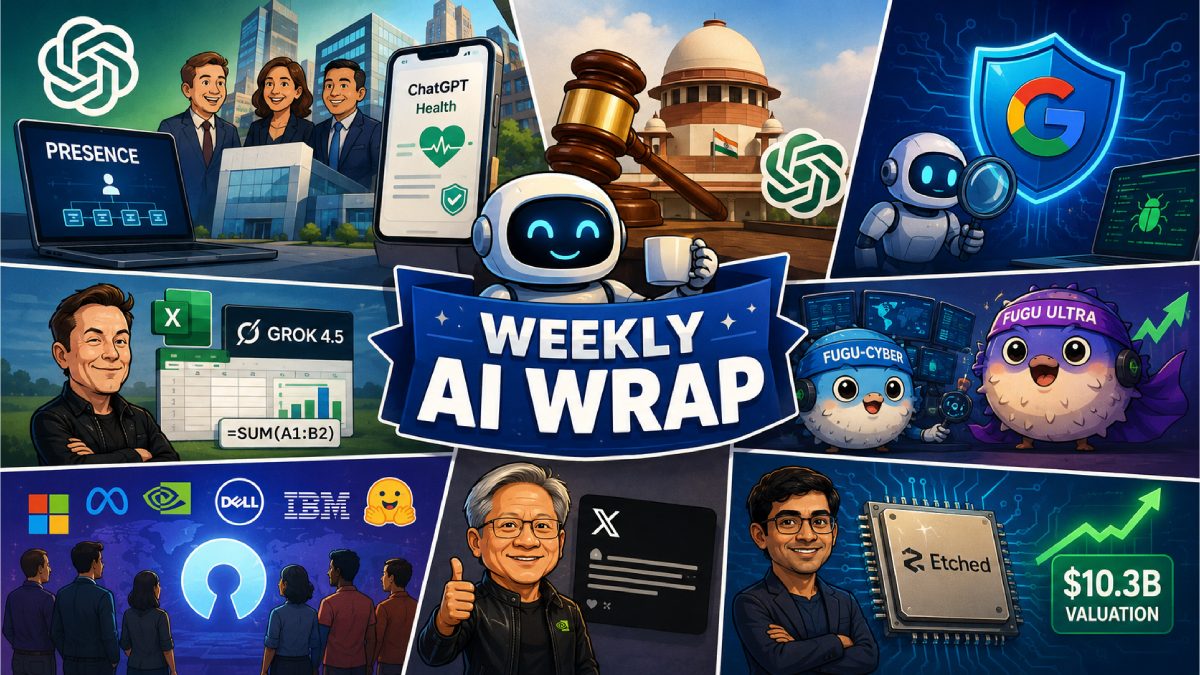
If you thought the mid-summer heat would slow down Silicon Valley, Shanghai, or New Delhi, think again. The past seven days proved that the global AI landscape doesn’t do “quiet weeks”— it only settles for varying degrees of controlled chaos. Between AI models learning to hunt zero-day bugs and legal systems reshaping the rules of model training, the AI industry spent the week being as busy as usual.
So grab your weekend coffee (or tea, or Matcha), kick back, and let’s decode the madness together.
While ‘Brother Sam’ was busy attempting to take over your enterprise software and your medical records, ‘Rocketman Musk’ decided your Sunday night spreadsheet sessions needed a heavy dose of his Grok. Over in Mountain View, Uncle Sundar’s team built a digital security guard, while a courtroom in New Delhi handed down a copyright ruling that had executive suites from San Francisco to Bengaluru pulling off early celebrations.
All this and a lot more. Hence, let’s jump right into the subject matter – a roundup of all things AI this week.
OpenAI drops ‘Presence’, officially launches ChatGPT Health
Brother Sam is flexing his corporate muscles again, and this week he brought the heavy enterprise artillery. OpenAI unveiled Presence, an architecture designed to link AI agents directly into complex internal corporate systems. Built to share context, permissions, and security guardrails across both voice and chat channels, the system is already undergoing enterprise pilots with powerhouses like BBVA, SoftBank, and IAG.
That wasn’t the only move from OpenAI. On July 24, the company officially launched ChatGPT Health, a dedicated health platform featuring HIPAA-compliant security protocols and encrypted data isolation. Users can sync fitness wearables, upload lab diagnostic PDFs, and receive structured medical summaries designed to prepare them for doctor consultations.
Meanwhile, details also leaked regarding Project Camellia — OpenAI’s massive planned 3.2-gigawatt AI data centre campus spanning 1,400 acres in Georgia.
Delhi High Court hands OpenAI a massive copyright victory
In what can only be called a landmark moment for the global AI ecosystem, the Delhi High Court delivered a decisive interim order in the copyright infringement lawsuit filed by news agency Asian News International (ANI) against OpenAI.
Justice Amit Bansal ruled that storing published news content to train Large Language Models falls squarely under the “fair dealing” exception of Section 52(1)(a) of the Indian Copyright Act, officially denying ANI’s plea for an interim injunction. While the court affirmed Indian jurisdiction to try the broader case, it held that text generated by ChatGPT did not constitute a “substantial reproduction” of ANI’s copyrighted material. The ruling sets a major legal precedent for AI training rights across Asia.
Google turns Gemini into a cyber-shield
Sundar Pichai and Google DeepMind decided to target cybersecurity with their latest Gemini updates. Google unveiled Gemini 3.5 Flash Cyber, a specialised vulnerability-hunting model trained on over 700,000 open-source vulnerabilities from OSV.dev and a decade of OSS-Fuzz data.
In internal stress tests targeting the V8 JavaScript engine, the model successfully uncovered 55 unique confirmed zero-day bugs. Access is strictly locked down for now, restricted to government entities and enterprise partners via Google’s CodeMender agent. Alongside the security model, Google also quietly rolled out Gemini 3.6 Flash and Gemini 3.5 Flash-Lite to offer developers high-speed, lower-cost inference choices.
Gemini for workspace to the living room
Beyond cybersecurity, Google rolled out a massive ecosystem-wide refresh for Gemini. Gemini 3.6 Flash gained enhanced multi-document analysis and tight integration into Gemini Canvas, giving developers real-time workspace collaboration tools.
Meanwhile, Google updated Gemini for Home, boosting conversational context memory to 15 minutes and bringing support for Gemini Live to first-gen Google Home Mini and Nest Hub devices. The Gemini Spark agent system unlocked deep workspace automation, enabling hands-free editing across Google Docs, Sheets, and Slides.
Elon sneaks Grok 4.5 into Microsoft Excel, Sakana AI drops Fugu Ultra
If you thought Elon Musk was going to let OpenAI have all the workspace fun, think again. xAI released a free Microsoft 365 add-in that embeds Grok 4.5 directly into Microsoft Excel side panels. Finance pros and spreadsheet fans can now run natural language prompts to clean data, write formulas, and perform live web research without ever leaving their workbooks.
Over in Tokyo, Sakana AI had a big week of its own. First, they introduced Fugu-Cyber, a multi-agent orchestration platform tailored for threat intelligence, followed quickly on July 24 by Fugu Ultra—which turned heads by posting a 73.7% score on the SWE-Bench Pro benchmark.
25 tech giants send open-weight AI manifesto to Washington
While individual companies were dropping models, a massive coalition formed on July 24 to influence AI policy. A total of 25 tech heavyweights and venture funds — including Microsoft, Meta, Nvidia, Dell, IBM, Hugging Face, and Andreessen Horowitz — signed an open letter to US lawmakers demanding explicit protections for open-weight AI models.
The group argued that open weights improve national security and systemic resilience through open scrutiny rather than creating single points of failure. The letter came as US officials simultaneously raised concerns regarding Chinese labs, notably Moonshot AI’s Kimi K3, allegedly distilling outputs from Western frontier models during training.
Jensen makes his first post on Musk’s X
Did you know that Jensen wasn’t on X? The Nvidia CEO undid that fact by making an account on Musk’s social media platform and making his first-ever post on X (formerly Twitter) on July 24 to express his support for open-weight models.
“For my first post, I’m sharing a letter @NVIDIA signed on why open models matter. AI will transform every industry, power every company, and be built by every country,” Huang wrote.
He argued that open weight models are crucial for national sovereignty and safety. He compared the current debate to the 1980s open-source software movement.
Dr Saptadeep Pal is the brain behind Etched’s $10.3 bn valuation
Dr Saptadeep Pal, an IIT Patna silver medalist and UCLA PhD graduate, is turning heads as the VP of ASIC & Architecture at AI hardware startup Etched. Fresh off the company’s massive $300 million Series C raise at a $10.3 billion valuation, Pal’s custom chip designs, including the flagship Sohu architecture, position Etched to challenge Nvidia’s dominance in AI transformer inference. Pal, who is a former Nvidia research engineer and Auradine co-founder, pioneered hardware breakthroughs like Low Voltage Inference (LVI), enabling multi-trillion-parameter AI models to run at ultra-low latency and peak energy efficiency.